
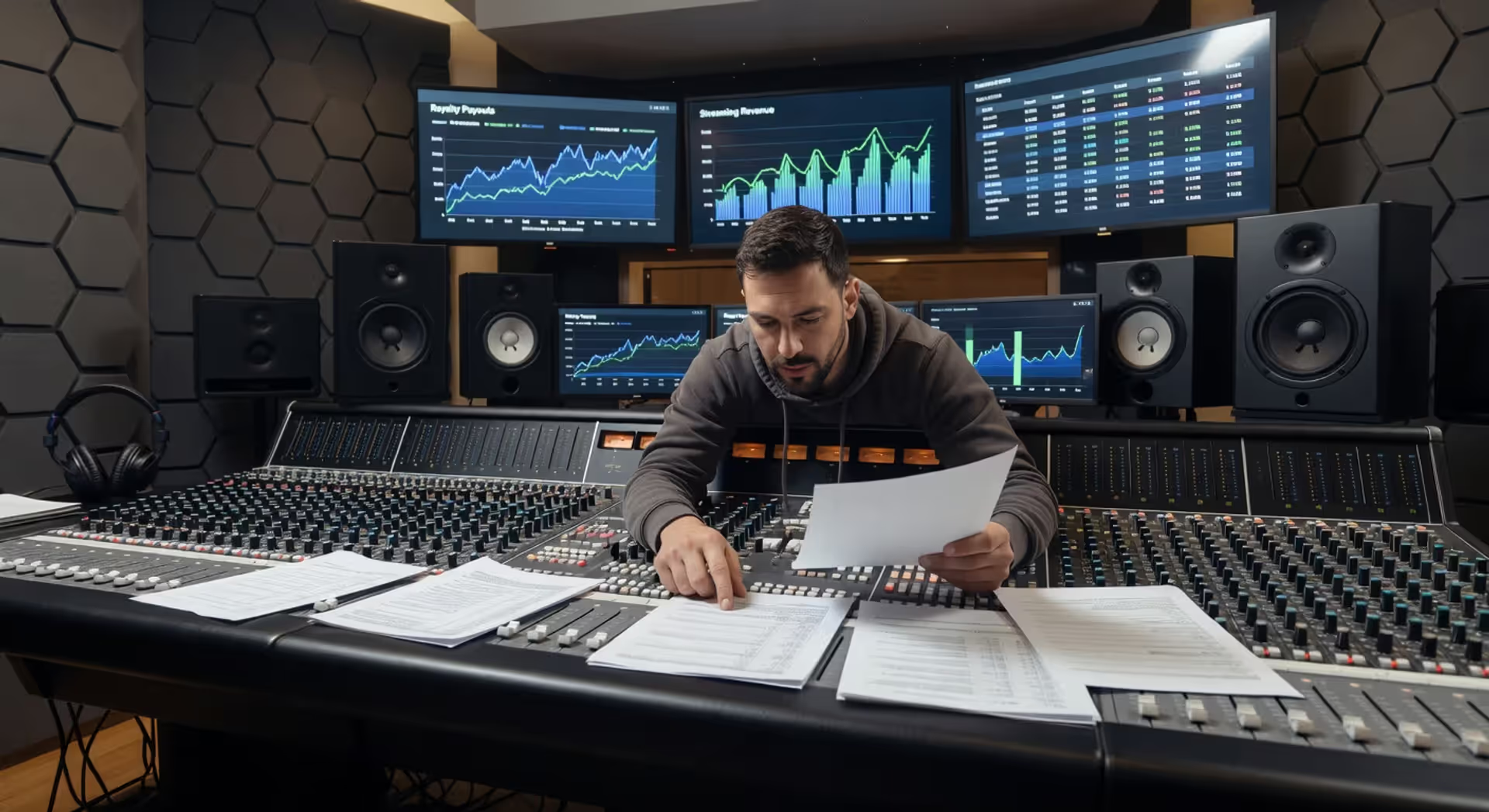
How Do Music Producers Get Paid for Their Work
How Do Music Producers Get Paid?

Content
Content
Understanding how music producers get paid can feel like navigating a maze. The reality is that producer compensation varies wildly depending on experience, project type, and negotiating power. Some producers walk away with a few hundred dollars for a beat sale, while others earn millions through royalty points on hit records. The payment structures aren't always straightforward, and many producers leave money on the table simply because they don't understand the system. Whether you're just starting out or looking to maximize your earnings, knowing the different ways producers earn money is the foundation of building a sustainable music production career.
Common Payment Structures for Music Producers
Music producers typically get compensated through one of three primary payment models in production: flat fees, hourly rates, or percentage-based deals. Each structure carries different risks and rewards.
Flat fees are the simplest arrangement. You produce a track or project, deliver the final product, and receive a one-time payment. This model is common for beat sales, work-for-hire projects, and commercial productions. The producer gets paid immediately but forfeits any future earnings if the song becomes successful. For many beginners, flat fees provide necessary cash flow without the uncertainty of backend royalties.
Hourly rates work similarly to studio session billing. Producers charge anywhere from $50 to $500+ per hour depending on their reputation and market. This structure works well for mixing, mastering, or production consultation services. The downside? Your income is directly tied to time spent, creating a ceiling on how much you can earn.
Percentage-based deals represent the most complex but potentially lucrative option. Instead of (or in addition to) upfront payment, producers negotiate points on the master recording and sometimes a share of publishing. This approach means you're investing in the song's future success. If it flops, you might earn little or nothing beyond any advance. If it hits, you could earn for years.
Many established producers use hybrid models that combine upfront fees with backend points. This balances immediate income with long-term earning potential. The pattern I see most often is producers requiring a minimum advance that's recoupable against future royalties, plus 2-5 points on the master.
Author: Savannah Quillmere;
Source: lamat-records.com
Producer Royalties and Points Explained
Producer royalties represent the backend compensation that keeps paying long after the initial session ends. Understanding royalties for producers requires knowing how streaming, sales, and performance royalties work together.
When people stream a song on Spotify, Apple Music, or other platforms, multiple royalty streams are generated. Producers can tap into both master recording royalties (through points) and potentially publishing royalties if they contributed to the songwriting.
Mechanical vs. Performance Royalties
Mechanical royalties are paid when a song is reproduced—whether through physical sales, downloads, or streams. Historically, these came primarily from CD and vinyl sales. Today, streaming services pay mechanical royalties to songwriters and publishers. If you contributed to writing the song (not just producing), you're entitled to a portion of these mechanicals.
Performance royalties are generated when a song is played publicly—on radio, in restaurants, at concerts, or through streaming services. Performance Rights Organizations (PROs) like ASCAP, BMI, and SESAC collect these royalties and distribute them to songwriters and publishers. Again, this applies if you have a songwriting credit.
Here's where it gets tricky: pure production work doesn't automatically entitle you to mechanical or performance royalties. Those belong to the songwriters and publishers. As a producer, your primary revenue stream comes from master recording points.
How Producer Points Work
Points (or "points on the master") represent a percentage of the master recording's revenue. One point equals 1% of the net revenue after certain deductions. If a producer has 3 points and a song generates $100,000 in net revenue, that producer earns $3,000.
But there's a catch—most points are calculated on net receipts, not gross revenue. The label deducts recording costs, marketing expenses, and other recoupable charges before calculating your share. On major label deals, this can significantly reduce what you actually receive.
Producer points typically range from 2-5% for newer producers to 6-10% for established names. Superstar producers might command 15% or more. These percentages are usually "all-in," meaning if you bring in additional engineers or musicians, you pay them from your share.
Streaming has complicated the math. With lower per-stream payouts, it takes millions of plays to generate significant royalty income. A song with 10 million Spotify streams might generate $30,000-$40,000 in total revenue. If you have 3 points on the net (after the label takes their cut), you might see $500-$1,000—not the windfall many expect.

Author: Savannah Quillmere;
Source: lamat-records.com
Upfront Fees and Advance Payments
Getting paid for production work often starts with negotiating upfront compensation. An advance is money paid before or during production, typically recoupable against future royalties. A non-recoupable fee is yours to keep regardless of the project's success.
For independent artists, producer fees might range from $500 to $5,000 per track. Mid-level producers working with established artists often command $10,000 to $50,000 per song. Top-tier producers can charge $100,000+ per track, plus points.
The key question: is the advance recoupable? If it's recoupable, the label or artist recoups that money from your share of royalties before you see additional payments. If you receive a $20,000 recoupable advance with 3 points, you won't see another dollar until your 3% share exceeds $20,000.
Non-recoupable advances are less common but more valuable. This money is guaranteed regardless of sales or streams. Some producers negotiate a hybrid: a portion non-recoupable (covering their time and expenses) and a portion recoupable against points.
Project type dramatically affects payment structures. Film and TV production work typically pays flat fees ranging from $5,000 to $100,000+ depending on the project's budget. Commercial work often pays even higher rates for shorter pieces. Album production might be negotiated as a package deal—say, $75,000 for 12 tracks plus 4 points on the album.
Beat sales to independent artists usually involve smaller upfront fees ($200-$2,000) with the option to negotiate points if the artist secures a major deal. Many producers use tiered licensing: a basic lease for $50-$200, exclusive rights for $500-$5,000.
Don't work without a clear payment schedule. Standard practice includes one-third upfront, one-third midway through production, and one-third upon delivery. This protects both parties and ensures cash flow throughout the project.
Additional Revenue Streams for Producers
Relying solely on production fees and royalties is risky. Diversifying your producer revenue streams creates stability and maximizes earning potential.
Beat sales through platforms like BeatStars, Airbit, and Traktrain provide passive income. Producers upload instrumentals with different licensing tiers. A basic lease might sell for $30-$50 (non-exclusive), while exclusive rights could fetch $500-$5,000. Successful beat makers sell dozens of leases monthly, creating consistent income between major placements.
Sync licensing—placing your music in films, TV shows, commercials, video games, and online content—can be lucrative. A single network TV placement might pay $2,000-$10,000. Major commercial syncs can reach $50,000+. Libraries and sync agencies help place your music, though they take 25-50% commission.
Sample packs and sound libraries represent another growing revenue stream. Producers create drum kits, loops, MIDI packs, and preset banks, selling them through platforms like Splice, Loopmasters, or their own websites. Prices range from $10 to $100+ per pack. A popular pack can sell thousands of copies, generating ongoing passive income.
Production courses and educational content have exploded. Producers teach their techniques through online courses ($50-$500), Patreon memberships ($5-$100/month), or YouTube ad revenue. Some producers earn more from education than production.
Mixing and mastering services provide steady income. Many producers offer these as separate services, charging $100-$500 per song for mixing and $50-$200 for mastering. This work is more predictable than waiting for royalty checks.
Live production and DJing create additional opportunities. Producers perform at clubs, festivals, and events, earning anywhere from $500 for local gigs to $50,000+ for major festival slots.
The simpler option usually wins here: don't overcomplicate your revenue model early on. Focus on one or two streams until they're profitable, then expand.
Payment Timeline and Collection Process
Understanding when producers actually receive money prevents frustration and cash flow problems. The timeline varies dramatically by payment type.
Upfront fees and advances should be paid according to your contract—typically within 30 days of invoice or upon reaching agreed milestones. If you're not getting paid on time, you have a contract enforcement issue, not a payment structure issue.
Royalty payments follow a much slower schedule. Labels and distributors typically pay quarterly, with a 60-90 day lag. So streaming revenue from January-March might not hit your account until July or August. This delay exists because platforms report to distributors, distributors calculate and report to labels, and labels calculate and pay producers.
For independent releases through distributors like DistroKid, CD Baby, or TuneCore, the timeline is faster—usually 30-60 days after the streaming service pays the distributor.
Performance royalties through PROs can take even longer. ASCAP, BMI, and SESAC distribute royalties quarterly or semi-annually, with reporting delays of 6-12 months. Radio play from January might not generate a royalty payment until the following year.
SoundExchange handles digital performance royalties (internet radio, satellite radio, streaming services) for master recording owners. If you own points on the master, you should register with SoundExchange. They pay monthly, but with a 45-90 day delay.
Tracking your royalties requires organization. Register with the appropriate organizations:
- A PRO (ASCAP, BMI, or SESAC) if you have songwriting credits
- SoundExchange for digital performance royalties on masters
- The Harry Fox Agency or your distributor for mechanical royalties
Many producers use royalty tracking services like Songtrust or Sentric Music to maximize collection. These services charge 10-20% commission but often recover royalties you'd otherwise miss.
Author: Savannah Quillmere;
Source: lamat-records.com
Common payment delays include incomplete paperwork, incorrect metadata, unregistered works, and international collection lag. Songs released globally can generate royalties in dozens of countries, each with different collection societies and timelines.
Here's a comparison of the main payment models:
| Factor | Flat Fee Only | Royalty Deal Only | Hybrid Model |
| Upfront Payment | Full payment upon delivery ($500-$50,000+) | Little to none; maybe small advance | Moderate advance ($2,000-$25,000) |
| Long-term Income | None after initial payment | Unlimited potential if song succeeds | Balanced ongoing revenue |
| Risk Level | Low risk, guaranteed income | High risk, income depends on success | Medium risk, some guarantee |
| Best For | Beginners, immediate cash needs, work-for-hire | Established producers, major label projects | Mid-level producers, growing artists |
| Typical Contract | Simple work-for-hire agreement | Complex with points, recoupment, splits | Moderate complexity, advance + points |
The biggest mistake I see producers make is not understanding the difference between recoupable and non-recoupable advances. You might think you're getting a great deal with a $50,000 advance, but if it's fully recoupable and you only have 2 points, you'll need massive sales before seeing another dime. Always negotiate at least a portion as non-recoupable to cover your actual costs.
— Moses Avalon
Producer Payment Mistakes to Avoid
Even experienced producers make costly errors that reduce their earnings. Here are the most common pitfalls.
Working without written contracts is the cardinal sin. Handshake deals and verbal agreements fall apart when money gets involved. A simple production agreement should specify: the fee or advance amount, whether it's recoupable, your points percentage, songwriting credits (if applicable), payment schedule, and deliverables. You don't need a 50-page contract, but you need something in writing.
Not registering with PROs leaves money on the table. If you contributed to writing the song—even just a melody or chord progression—you're entitled to performance royalties. But you'll only receive them if you're registered with ASCAP, BMI, or SESAC and properly credited. Thousands of dollars in performance royalties go unclaimed because producers don't register their works.
Unclear split agreements cause problems later. Before the session ends, document who created what. If you wrote the chord progression and melody, that's songwriting—you deserve publishing. If you only arranged existing elements, that's production. The distinction matters because it determines which royalty streams you access. Use split sheet apps like Jammber or Splits.io to document agreements immediately.
Missing publishing credits is common when producers don't assert their songwriting contributions. If you created melodic elements, chord progressions, or structural arrangements that constitute songwriting, you own part of the composition. Don't let artists or labels exclude you from publishing just because you're "the producer."
Accepting all-recoupable advances without understanding recoupment is dangerous. If you receive a $30,000 recoupable advance with 3 points, and the artist's recording costs total $200,000, you might wait years before seeing additional money. Negotiate at least partial non-recoupable payment to cover your time and expenses.
Not tracking your work makes royalty collection nearly impossible. Keep detailed records of every song you produce: artist name, song title, release date, your percentage of points, songwriting splits, and where it's distributed. When royalty statements arrive (often with unfamiliar song titles or misspellings), you'll need this information to verify accuracy.
Failing to invoice promptly delays payment. Send invoices immediately upon reaching payment milestones. Include all necessary information: your business name, tax ID, payment terms, and bank details for direct deposit.
FAQ: Producer Payment Questions Answered
Understanding how producers earn money is just the beginning. The real skill lies in structuring deals that protect your interests while building long-term relationships. Don't chase every opportunity—focus on projects where the payment structure aligns with your current needs and career goals. Early on, upfront fees might matter more than backend points. As you build a catalog and reputation, royalty deals become more attractive. Track everything, register your works properly, and never work without a contract. The producers who build sustainable careers aren't always the most talented—they're the ones who understand the business side and protect their revenue streams.
Related Stories
Read more

Read more




The content on this website is provided for general informational and educational purposes only. It is intended to explain concepts related to music production, recording, mixing, mastering, music industry roles, and distribution.
All information on this website, including articles, guides, and examples, is presented for general educational purposes. Results and success in music production may vary depending on skill level, equipment, and effort.
This website does not provide professional music production services or guarantees of commercial success, and the information presented should not be used as a substitute for consultation with qualified music producers, audio engineers, or music industry professionals.
The website and its authors are not responsible for any errors or omissions, or for any outcomes resulting from decisions made based on the information provided on this website.