
What Is a Grand Piano and How Does It Work
What Is a Grand Piano?

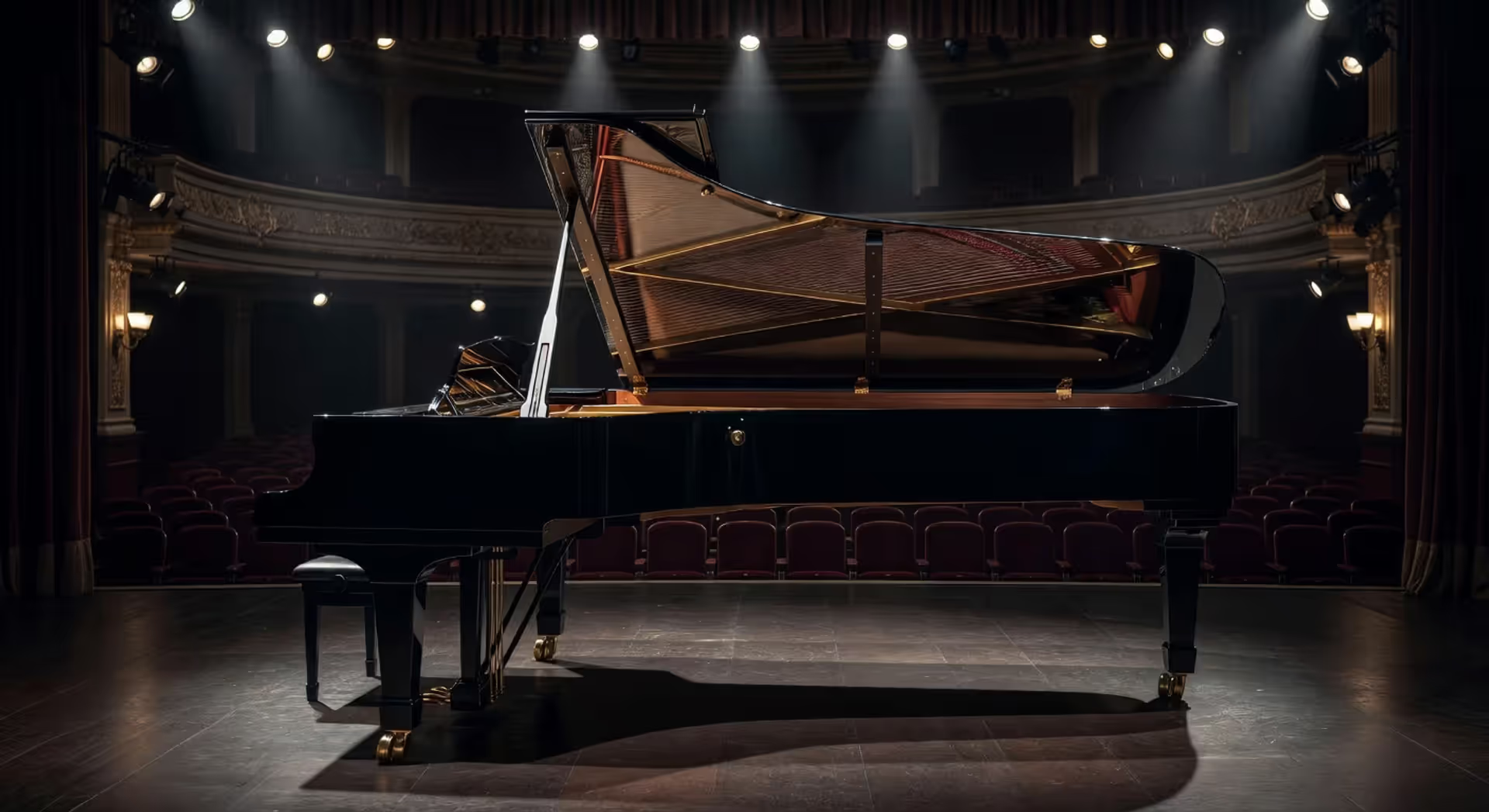
For over 300 years, the grand piano has dominated concert stages, recording studios, and living rooms where serious music happens. You've probably seen one—that distinctive wing-shaped instrument with the lid propped open. But there's a lot more going on than just an impressive silhouette.
The real story is what's happening inside. When you press a key, you're setting off a chain reaction involving dozens of moving parts, all timed to the millisecond. The way those strings stretch out horizontally instead of standing upright? That's not just about looks. It completely changes how the instrument responds to your touch and how the sound fills a room.
Let's dig into what actually makes a grand piano work—and why pianists are willing to pay a premium for one.
Defining the Grand Piano
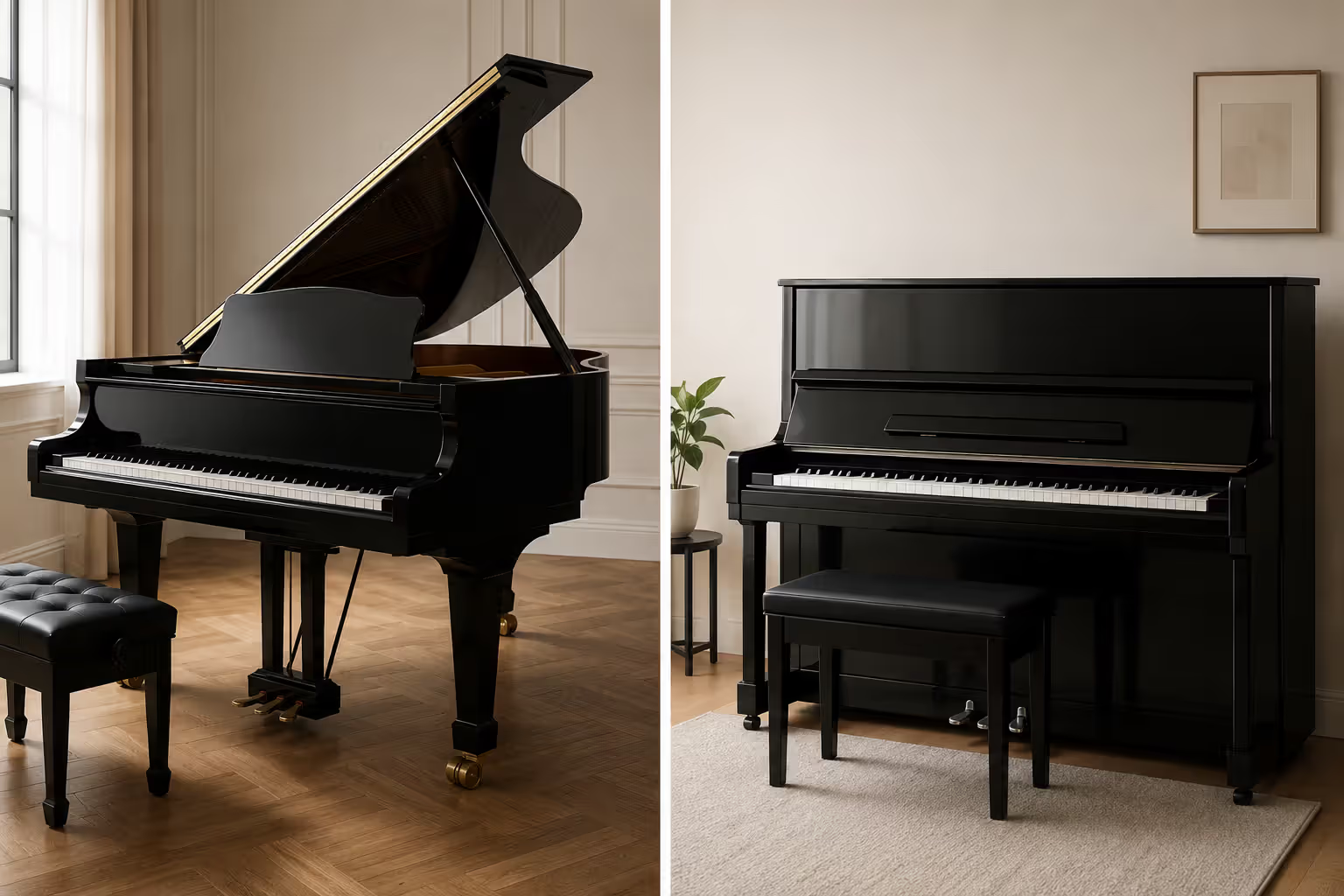
Here's the simple version: a grand piano lays its strings flat, running away from you as you sit at the keyboard. Compare that to an upright, where the strings stand vertical to save floor space.
The word "grand" comes from the French—it originally just meant "big." Makes sense when you consider that early pianos took up half a room. In fact, when Bartolomeo Cristofori invented the piano around 1700, horizontal construction was the only option. Uprights didn't show up until the late 1700s, when instrument makers started looking for ways to fit pianos into smaller European apartments.
Every grand piano, regardless of size, has three things in common:
- Horizontal string layout
- Hammers that drop back down using gravity (no springs needed)
- A hinged lid you can open to direct sound
You can find grands as short as 4'5", though purists will argue those barely count. Still, even the smallest ones keep that horizontal design—and that makes all the difference in how they play.
How a Grand Piano Produces Sound
Press down a key. Seems simple, right? You've just kicked off a mechanical sequence that involves about 30 separate components.
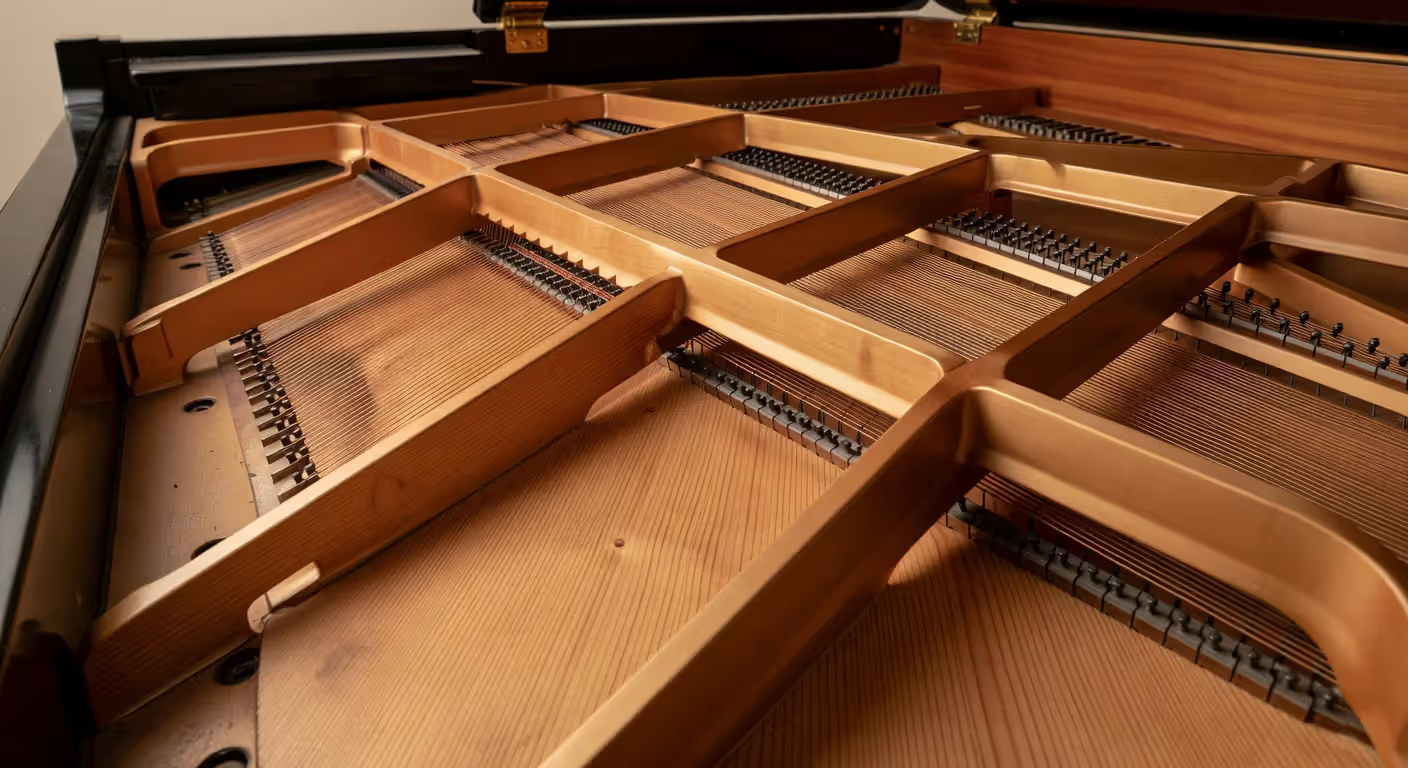
Your finger pushes the key down like a lever. The back end rises, which shoves a complex mechanism called the action into motion. This launches a felt-covered hammer toward the strings—but here's the clever part. Just before impact, an escapement releases the hammer completely. It flies the last quarter-inch on its own.
Author: Miles Arbordale;
Source: lamat-records.com
Why does that matter? If the hammer stayed connected, it would immediately choke the string. Instead, it bounces back after the hit, and a backstop catches it halfway to prevent a double strike you didn't ask for.
At the same time, felt dampers lift off the strings when you press the key. These are basically silencers—they normally rest against the strings to keep them quiet. Let go of the key, and the dampers drop back down. Sound stops.
Most people have no idea this is happening under the hood. Each key coordinates roughly 30 parts, all moving in perfect sync within about 50 milliseconds.
Key Components and Their Functions
Strings are made from high-tensile steel wire under ridiculous tension—around 200 pounds per string. Multiply that across 230+ strings, and you're looking at nearly 18 tons of force trying to rip the piano apart. That's why the cast iron frame weighs 300-400 pounds. Most notes use three strings tuned to the same pitch, which creates a fuller sound through tiny natural variations.
Hammers aren't one-size-fits-all. Bass hammers are big and soft. Treble hammers are small and firm. This gradation keeps the tone balanced—otherwise the high notes would pierce your ears and the low notes would thud like a drum.
The action is everything between the key and the string—hammers, dampers, and about two dozen levers and pivots per note. Grand actions use gravity to reset the hammer. That's huge. It means you can repeat a note up to 14 times per second on a good instrument. Uprights use springs for this, which maxes out around 7 repetitions. Try playing a fast trill and you'll feel the difference immediately.
Pedals do three different things. The right pedal (sustain) lifts every damper at once, letting notes ring together. The left pedal (soft) physically shifts the entire keyboard sideways so hammers only hit two of the three strings—quieter, but also a different tonal color. The middle pedal (sostenuto) is weird—it only sustains notes you're already holding when you press it. Most people never use it, but it's essential for certain repertoire.
The Role of the Soundboard in Tone Quality
Vibrating strings by themselves are nearly silent. Too thin to move much air. That's where the soundboard comes in.
This is a large wooden panel—usually Sitka spruce from coastal Alaska or British Columbia—that sits under the strings. When a string vibrates, that energy transfers through the bridge to the soundboard. The board's huge surface area amplifies the vibration by a factor of 100 or more. Without it, you'd barely hear the piano from across the room.
Quality here determines 60-70% of the instrument's sound. The wood needs precise tapering—thicker in the center, thinner at the edges. It's also built with a slight upward arch called "crown," which maintains pressure against the strings and keeps the tone focused.
Soundboards age. They crack, lose their crown, or separate from the ribs that support them. This is why some old pianos sound dead even though the keys and hammers work fine. The amplification system has failed.
Grand Piano vs Upright Piano
Choosing between these two isn't just about space and money, though those obviously matter.
Action response is fundamentally different. Grand hammers reset by falling. Gravity is free, instant, and never wears out. Upright hammers need springs to push them back, which limits repetition speed to roughly half what a grand can do. If you're playing Chopin or Liszt, you'll hit that ceiling fast.
Sound projection works differently too. Grands send sound up and out. Open the lid and you're directing acoustic energy toward your audience. Uprights fire sound backward into whatever wall they're against. Sometimes that wall helps, sometimes it muddies everything. You have less control either way.
Author: Miles Arbordale;
Source: lamat-records.com
String length gives grands an acoustic advantage. A 5-foot grand has longer bass strings than a 4-foot upright. Longer strings vibrate more freely and produce richer harmonics. You hear this most in the bottom two octaves—fuller, more complex tone.
Floor space is where uprights win. A baby grand needs about 5' × 6' of clearance, plus room for the bench. An upright sits against a wall in a 2' × 5' footprint. For apartments or tight spaces, that's the deciding factor.
Cost varies wildly, but uprights generally run cheaper at similar quality levels. Decent uprights start around $4,000 and top out around $12,000 for consumer models. Baby grands begin near $8,000 and climb past $30,000 for professional-grade instruments. Concert grands? Six figures, easily.
Here's the thing people get wrong: they assume any grand beats any upright. Not true. A high-end Yamaha or Kawai upright will outperform a cheap baby grand every time. Build quality matters more than orientation when you're shopping under $15,000.
Main Types of Grand Pianos
Grand pianos come in five standard sizes. Each one fits different spaces and purposes.
| Type | Length | Where You'll Find Them | What They Cost | Room Size Needed |
| Petite | 4'5" to 4'10" | Apartments, small teaching studios | $8,000 to $20,000 | 10' × 12' minimum |
| Baby | 5' to 5'6" | Homes, private lessons | $12,000 to $40,000 | 12' × 14' minimum |
| Medium/Parlor | 5'7" to 6'2" | Dedicated music rooms, small venues | $25,000 to $70,000 | 14' × 16' minimum |
| Semi-Concert | 6'3" to 7'4" | University practice rooms, recital halls | $50,000 to $100,000 | 16' × 20' minimum |
| Concert | 7'5" to 9'+ | Major concert halls, professional studios | $100,000 to $200,000+ | 20' × 30' minimum |
Petite grands sacrifice some bass depth because of short string length, but they keep the responsive action that makes grands special. There's debate about whether a good upright sounds better at this size. Probably does, honestly.
Baby grands dominate home sales. At 5' to 5'6", they balance decent sound with manageable size. Yamaha, Kawai, and other major brands focus most of their R&D budget here. It's where the market is.
Medium grands hit a sweet spot for serious players. The extra length—even just 6 to 8 inches—produces noticeably fuller bass and better tonal balance. If you've got the space and budget, this is where you get the most piano for your money.
Semi-concert instruments populate conservatories and teaching studios. Big enough for advanced repertoire, small enough to fit in medium-sized rooms. Steinway's Model B (6'11") is the standard here.
Concert grands define professional performance. Steinway's Model D stretches 8'11¾". Yamaha's CFX goes 9'. These instruments can fill a 2,000-seat hall without amplification. They're also expensive enough to require insurance riders and climate-controlled storage.
The horizontal string layout isn't a luxury—it's physics. Gravity returns the hammer naturally, without fighting springs or dampers. That's why grands respond to the subtlest touch variations that uprights simply can't capture, no matter how well they're built.
— Mason Daniel
What Makes Grand Piano Sound Unique
Grand piano tone has qualities that other keyboard instruments struggle to match—even expensive digital pianos with multi-gigabyte sample libraries.
Sustain extends naturally and evenly. Hold a note on a well-maintained grand and it rings for 20 to 30 seconds, fading smoothly the whole time. The horizontal strings and large soundboard keep vibration going longer than vertical designs can. This matters enormously in slow, lyrical passages where notes need to blend and resonate.
Dynamic range runs from barely audible whispers to wall-shaking fortissimos. A concert grand can produce over 100 decibels—as loud as a chainsaw—but also respond to touches so light they barely move the key. That's roughly six octaves of dynamic control. It gives performers expressive tools that other instruments can't provide.
Harmonic complexity comes from how strings interact with the soundboard. Strike middle C and you're not just hearing 261.6 Hz. You're hearing that fundamental plus a whole series of overtones—523 Hz, 785 Hz, 1047 Hz, and dozens more, each at different volumes. The soundboard emphasizes some harmonics and dampens others, creating the characteristic "piano sound" that synthesizers still can't quite nail.
The horizontal layout contributes more than you'd think. Longer strings oscillate in more complex patterns, generating richer overtone series. Also, because hammers strike from below in grands (instead of horizontally from behind in uprights), the impact angle changes which harmonics get emphasized.
Tonal consistency across the keyboard separates great grands from mediocre ones. Cheap instruments often sound bright and thin in the treble, muddy in the bass. Premium grands maintain even tonal character from the lowest A to the highest C, with smooth transitions between registers.
Why do different brands sound so different? Design philosophy, mostly. Steinway goes for warm, singing tone with slow-release hammer felt. Yamaha leans toward brighter, more articulate sound with firmer felt. Bösendorfer extends the keyboard down to low C—eight extra keys—for deeper bass resonance.
Materials matter too. Soundboards made from high-altitude spruce sound different than lowland wood. Rim construction—bent from continuous laminations versus assembled from segments—affects how the case reinforces or absorbs vibration. Even the type of felt on the hammers changes everything.
Author: Miles Arbordale;
Source: lamat-records.com
Common Questions About Grand Pianos
Grand pianos pack centuries of acoustic engineering into instruments capable of extraordinary musical expression. The horizontal design, gravity-assisted mechanisms, and carefully crafted soundboards create tonal qualities other keyboards can't duplicate. Whether you're considering a compact baby grand for your home or just curious what makes these instruments special, understanding the mechanics and physics reveals why they've remained essentially unchanged in basic design for 200+ years. The right grand piano isn't furniture—it's a tool for musical communication that responds to your subtlest intentions and rewards developing skill with increasingly profound expressive possibilities.
Related Stories
Read more

Read more

The content on this website is provided for general informational and educational purposes only. It is intended to explain concepts related to music production, recording, mixing, mastering, music industry roles, and distribution.
All information on this website, including articles, guides, and examples, is presented for general educational purposes. Results and success in music production may vary depending on skill level, equipment, and effort.
This website does not provide professional music production services or guarantees of commercial success, and the information presented should not be used as a substitute for consultation with qualified music producers, audio engineers, or music industry professionals.
The website and its authors are not responsible for any errors or omissions, or for any outcomes resulting from decisions made based on the information provided on this website.